
Can Bhavish Aggarwal upend the electric two-wheeler market, which is now overwhelmingly in favour of scooters?

"Lady candidates need not apply." So read the postscript in a job notice from Telco (now Tata Motors) on a notice board in the corridors of the Indian Institute of Science, Bangalore (now Bengaluru), in 1974. Irked, Sudha Murty, who was then pursuing her masters in computer science at the institute, wrote a postcard to JRD Tata, expressing her surprise at this gender discrimination, especially since the Tata Group were pioneers on many fronts. Shortly, Murty became the first woman on the firm's shop floor.

Buying a car, particularly a diesel-powered one, is set to pinch the customers' pockets even more from the next financial year, as the second phase of Bharat Stage VI (BSVI) emission norms kicks in. The rules require cars to be compliant with real driving emission (RDE) norms, which measure pollutants emitted by cars while they are being driven on the road, unlike in a laboratory test. The norms may increase the cost of producing diesel vehicles by nearly Rs 75,000 to Rs 80,000, and petrol-powered ones by Rs 25,000 to Rs 30,000, analysts said.


What worked for Hyundai in India when so many other auto manufacturers have had to eat humble pie? Pavan Lall finds out.

Engineers based in India are estimated to be writing roughly 35 per cent of the 100 million lines of codes required to develop one fully driverless car for global vehicle makers.

India needs to make use of this opportunity to significantly enhance its exports especially in information and communications technology and the automotive sector.

Tata Motors, India's largest electric passenger vehicle manufacturer, has signed an agreement with ride-hailing company Uber to supply 25,000 electric vehicles (EVs), the company said. The agreement is the largest EV commitment between an automotive manufacturer and a ride-sharing platform in India. Under the agreement, Uber will deploy Tata Motors' XPRES-T EVs by partnering fleet operators in Delhi National Capital Region, Mumbai, Kolkata, Chennai, Hyderabad, Bengaluru, and Ahmedabad.

The previous May peak was observed in 2018 when the domestic PV wholesales stood at 301,238 units.

Equity mutual funds (MFs) deployed maximum in shares of Reliance Industries (RIL) in June at Rs 2,177 crore, followed by Maruti Suzuki (Rs 2,045 crore) and Bharti Airtel (Rs 1,310 crore). Shares of both RIL and Bharti Airtel have been turbulent this month. On July 1, shares of RIL crashed over 7 per cent, following the government imposing windfall taxes on domestic crude oil production and fuel exports.

Expanding investigation into allegedly wrongful claims of input tax credit by insurance companies, the tax authorities are probing a section of automobile dealers who have supposedly generated fake invoices without providing any service, which is a punishable offence under goods and services tax (GST) law. The authorities are learnt to have questioned the car dealers to explain the services they provided general insurance companies. The investigators suspect car dealers pitched for insurance schemes that give them commissions in excess of those insurance regulations permit.

What technologies do you fancy in your new car? Here are some popular cars in India with the most sought after technologies.

The government is considering the option of inviting fresh applications to bid for the fourth slot which fell vacant after one of the initial candidates who qualified, Hyundai Global Motors, exited from the production-linked incentive (PLI) scheme for advanced chemistry cell battery storage with a capacity of 20 GwH. Earlier, stakeholders had expected that the vacant slot would be offered to waitlisted players ranked on their technical and financial offer. A final decision will be taken soon.

Renault will recall 646 units of hatchback Pulse and mid-sized sedan Scala in India, manufactured between September 2011-July 2012, to fix faulty driver side air bags.
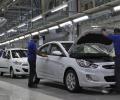
Automakers Maruti Suzuki, Tata Motors, Mahindra & Mahindra and Kia reported robust growth in their vehicle dispatches in the domestic market for August buoyed by festive demand and easing of semiconductor shortage woes. Other manufacturers like Hyundai, Toyota and Skoda also reported growth in wholesales in August as compared with the same month last year. The country's largest automaker Maruti Suzuki India said its domestic passenger vehicle dispatches increased by 30 per cent to 134,166 units in August as compared with 103,187 units in the year-ago month.
'It says, we are not just an overseas player -- we are Kia India and here for good'

Following a strong performance in the 2022-23 January-March quarter, publicly listed paint industry giants displayed a mixed performance in the 2023-24 (FY24) April-June quarter. While Berger Paints India outperformed its peers and reported results in line with expectations, market leader Asian Paints and Kansai Nerolac Paints fell slightly short of expectations.

The institutional portion was subscribed 143 times, the wealthy investor portion by 360 times and the retail investor portion by 24.5 times.
Automotive retail sales saw a 14 per cent rise in March on a year-on-year (YoY) basis, according to data released by the Federation of Automobile Dealers Associations (FADA). For the whole of financial year 2022-23 (FY23), sales grew 21 per cent YoY. For both March and the financial year, all categories, except for tractors, and including two-wheelers, three-wheelers, passenger vehicles (PVs), and commercial vehicles (CVs), posted double-digit growth. However, the total retail sales of 22.1 million for the financial year were still 12 per cent lower than the pre-Covid (FY20) level of 25 million, owing to an 18 per cent dip in the two-wheeler segment.

The EV industry is at an inflection point and batteries will play a critical role ahead -- batteries and related components typically constitute 35-45 per cent of an EV's costs.
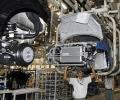
Hyundai Motor and Toyota Kirloskar Motor have announced the suspension of manufacturing operations at their respective plants amid coronavirus outbreak. On Sunday, various automakers like Maruti Suzuki India, Honda Cars, Mahindra & Mahindra and Fiat announced a temporary halt in manufacturing operations at their respective facilities.

'The reason being we cannot let premiums go beyond a certain point.'

Nearly a decade ago, the first fully electric vehicle (EV) caught fire on the road in the US. It was a model from Tesla, the world's most admired EV maker. A metal fragment punctured the underbelly of the vehicle, penetrating its battery pack, leading to a fire. Indian lawmakers and automakers have had nine years to study the incident (in fact, three Tesla Model Ss caught fire in two months in 2013) but seem to have learnt little.

It will overtake Brazil, Germany and Japan.

Unemployment rate in the country has zoomed to a high of 8.3 per cent in December, the highest in 2022, according to data from Centre for Monitoring Indian Economy (CMIE). The unemployment rate during November was at 8 per cent, while in September it was the lowest at 6.43 per cent and was at the second highest level during the year at 8.28 per cent in August, the CMIE data stated. While the urban unemployment rate was at 10 per cent during the last month of 2022, rural joblessness stood at 7.5 per cent during December.

Leading automakers Maruti Suzuki India, Hyundai and Tata Motors reported a double-digit increase in dispatches to dealers in April as the demand remained robust especially for the sports utility vehicles. The country's largest car maker Maruti Suzuki India (MSI) said its domestic passenger vehicle wholesales rose 13 per cent to 137,320 units last month as against 121,995 units in April 2022. Sales of mini cars, comprising Alto and S-Presso, fell 18 per cent to 14,110 units as compared with 17,137 units a year ago.

'The Fed rate will peak in the range of 5.1-5.3 per cent during the second quarter of CY23 and will most likely stay there for a while before rate cuts start in CY24.'

'As the Indian economy continues to expand over the next three years, mid- and small-caps should do well as they have higher exposure to the domestic economy than large-caps.'
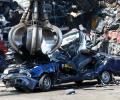
One of the challenges for those car graves is that Indian owners often find markets for their old cars rather than send them to scrapyards.

'Right now, we are increasing production in anticipation of the demand during the festive season.' 'If the demand doesn't come back, all the production will languish in the factories.'

Driven by strong demand, the overall passenger vehicle dispatches crossed 3.35 lakh units in February as automakers, including Maruti Suzuki India, Hyundai, Tata Motors and Mahindra & Mahindra, reported robust sales during the month. The dispatches of more than 3.35 lakh units last month marked an 11 per cent over February 2022. It was also the highest ever overall wholesales in the month of February. The country's largest carmaker Maruti Suzuki India on Wednesday said its domestic wholesales rose 11 per cent to 155,114 units in February as compared with 140,035 units in the same month last year.

Jeep India, a part of automotive group Stellantis, on Tuesday announced the opening of bookings for its upcoming SUV Meridian, the production of which has also commenced from its joint venture manufacturing facility at Ranjangaon, Maharashtra. Customers can book the Meridian either at Jeep India dealership network or through the company's website with a down payment of Rs 50,000. Deliveries of the vehicle will start in June, it said in a statement.
Jeep India, a part of automotive group Stellantis, on Tuesday announced the opening of bookings for its upcoming SUV Meridian, the production of which has also commenced from its joint venture manufacturing facility at Ranjangaon, Maharashtra. Customers can book the Meridian either at Jeep India dealership network or through the company's website with a down payment of Rs 50,000. Deliveries of the vehicle will start in June, it said in a statement.

After lagging behind other segments in the automotive (auto) space over the past few years, two-wheelers are expected to reverse their volume underperformance. After witnessing a 36.3 per cent volume decline over the 2018-19 (FY19) through 2021-22 (FY22) periods, the sector staged a recovery in 2022-23 (FY23), with volumes rising 17 per cent. While volumes are still a quarter lower than the FY19 peak of 21 million units, a double-digit growth trajectory is expected to prolong.

India's traditional companies are now moving full scale into the renewable and alternative energy space that had been dominated by smaller players over the past decade. Companies such as government-owned NTPC and the Adani and the Tata groups restructured their businesses well in time to become major players in the green space. At the same time, other conventional companies, such as Larsen & Toubro and Reliance Industries Ltd (RIL), which have a presence both in the energy sector as well as myriad other activities - construction, technology and retailing - are tying up with new-age companies to hitch a ride to a greener path.

India's electric mobility goal, which has so far been riding on two wheels, is all set to graduate to four wheels. At least, the journey has begun. Hyundai Motor India said it would invest Rs 4,000 crore till 2028 to launch half-a-dozen electric vehicles (EVs) in India. It would eventually straddle premium and mass segments. The first of these - the electrified version of an internal combustion engine (ICE)-powered model - will go on sale as early as next year.

What will it take for Tesla to plug and play in India? Sector pundits say it's a mix of strategy, getting the price right, timing, the right talent, and above all, patience.

There will be two variants on sale -- namely the F77 and the F77 Recon, priced at Rs 3.8 lakh and Rs 4.55 lakh (ex-showroom) respectively.

With car penetration of around 22 per 1,000 population, India continues to be a big opportunity to sell cars, especially in rural areas.

According to reports, by last year, the company has helped its customers save 15 per cent on costs -- around 5-6 per cent on fuel and 15 per cent on fleet utilisation through digital measures.
